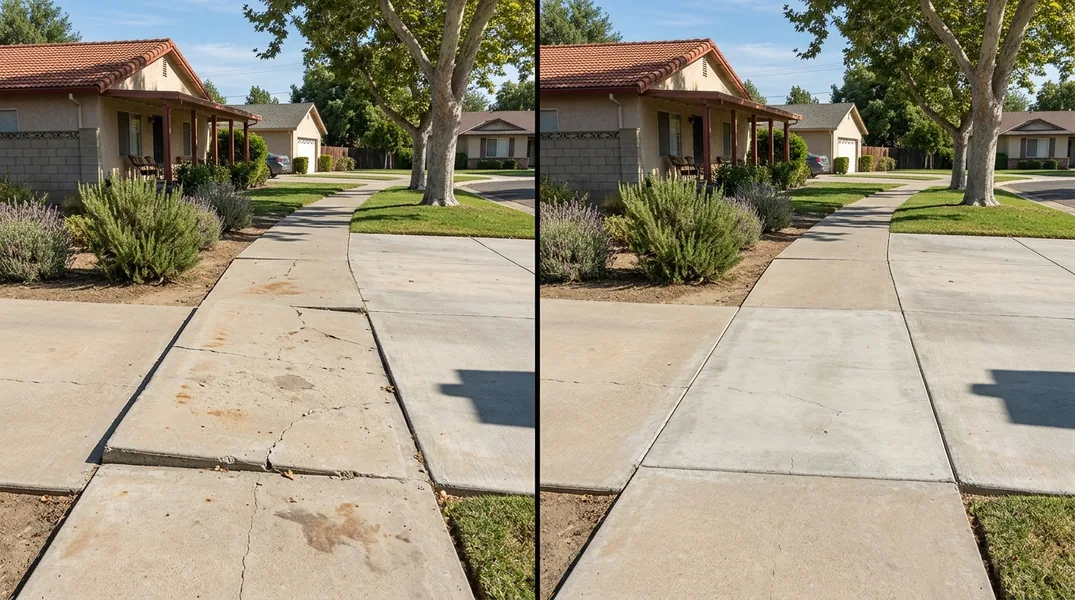
What Is Caliche Hardpan and Why Does It Matter in Fresno?
If you own a home in Fresno, you've probably noticed that concrete problems seem to plague the neighborhood. Cracked driveways, settling patios, and foundation issues are so common that many homeowners assume it's just part of life in the Central Valley. The culprit? Caliche hardpan, a dense, calcium carbonate-rich layer buried beneath the surface soil that makes Fresno's ground particularly hostile to concrete structures.
Caliche hardpan forms over thousands of years in arid and semi-arid climates like ours. It's essentially a cemented layer of soil particles, minerals, and calcium carbonate that becomes rock-hard when exposed to the region's dry conditions. In the Central Valley, this layer typically sits 18 to 36 inches below the surface, directly in the zone where concrete foundations, driveways, and patios must rest. When contractors don't account for caliche during installation or when the underlying soil shifts due to moisture changes, concrete can crack, settle unevenly, or fail prematurely. Understanding this geological reality is the first step toward protecting your investment.
How Caliche Hardpan Causes Central Valley Concrete Damage
The relationship between caliche hardpan and concrete failure isn't immediately obvious to most homeowners, but the mechanics are straightforward. Caliche is impermeable, meaning water cannot pass through it easily. When a Concrete Driveway is poured directly on soil above caliche, water from rain or irrigation can pool underneath the concrete instead of draining away. This creates a wet, unstable foundation that shifts and settles unevenly, causing the concrete surface to crack, heave, or sink.
Additionally, the clay loam soil common throughout Fresno and the surrounding Central Valley expands when wet and contracts when dry. Because caliche blocks drainage, this soil experiences extreme moisture fluctuations, leading to significant volume changes. Your driveway or patio rides these waves of expansion and contraction, developing stress fractures that worsen over time. The freeze-thaw cycle, while less severe here than in northern states, still contributes to the problem. When moisture does penetrate small cracks in the concrete, it can freeze on cold winter nights and force the concrete apart from within.
Clay Loam Foundation Cracking: The Fresno Problem
Clay loam is the dominant soil type across much of Fresno and the Central Valley, and it's one of the most challenging soil types for concrete construction. Clay loam contains a high percentage of clay particles, which are extremely reactive to moisture. When clay loam dries out, it shrinks dramatically, creating voids and settling beneath your concrete. When it absorbs water, it swells, pushing upward and causing heaving. This constant movement is relentless and unforgiving to rigid concrete structures.
The problem is compounded when caliche hardpan sits just below the clay loam layer. The caliche acts as a moisture barrier, preventing water from draining deeper into the soil profile. This means the clay loam layer above the caliche experiences more intense wet-dry cycles than it would in a more permeable soil environment. Homeowners in Fresno often find that their concrete develops a distinctive pattern of cracks that radiate outward from a central point, or they notice one corner of a driveway sinking while another corner remains level. These are classic signs of clay loam and caliche interaction beneath the surface.
Signs Your Concrete Has Caliche Hardpan Damage
Recognizing the early warning signs of caliche hardpan damage can help you address problems before they become expensive. The most common indicator is uneven settling, where one section of your driveway or patio sits noticeably lower than an adjacent section. You might notice a lip or step where two concrete slabs meet, or a gradual slope that wasn't there when the concrete was new. Cracks are another telltale sign, particularly diagonal or stair-step cracks that suggest differential settlement rather than simple age-related wear.
Water pooling on your driveway after rain is another red flag. If water sits on the concrete surface instead of running off, it suggests that the concrete has settled and created low spots. Over time, this standing water infiltrates the concrete, accelerates deterioration, and worsens the underlying problem. If you notice that cracks seem to grow larger each year, or if you see white powder (efflorescence) seeping from cracks, these are signs that moisture is moving through the concrete and minerals are being leached out. Any of these symptoms warrant a professional inspection. Fresno Concrete can evaluate your situation and recommend whether Concrete Repair & Resurfacing is appropriate or whether the damage is too extensive for repair alone.
Prevention and Repair Strategies for Caliche-Related Concrete Problems
The best defense against caliche hardpan damage is proper installation from the start. Professional concrete contractors in Fresno understand the local soil conditions and should take steps to mitigate the caliche problem. This includes excavating deeper than typical to break through the caliche layer, installing proper drainage systems to divert water away from the concrete foundation, and using a compacted gravel base that allows water to permeate through to deeper soil layers. Some contractors recommend adding a layer of permeable geotextile fabric or installing French drains to manage moisture more effectively.
If your concrete is already damaged, the solution depends on the severity of the problem. Minor cracks and settling can often be addressed through Concrete Repair & Resurfacing techniques such as crack sealing, polyurethane injection, or concrete leveling. More severe cases may require removal and replacement of the affected concrete sections. In some situations, addressing the underlying caliche issue is necessary to prevent the new concrete from failing in the same way. This might involve installing a subsurface drainage system or using specialized foundation preparation methods that account for the local geology.
Concrete Repair Near Me: When to Call a Professional in Fresno
If you're seeing signs of caliche hardpan damage in your driveway, patio, or other concrete surfaces, waiting typically makes the problem worse and more expensive to fix. The longer damaged concrete sits, the more water infiltrates the substrate, the more the underlying soil shifts, and the greater the risk of additional cracking and settling. A professional assessment from a local contractor who understands Central Valley geology is invaluable. Fresno Concrete has years of experience working with Fresno's unique soil conditions and knows exactly what to look for when evaluating caliche-related damage.
Getting a free estimate is the smart first step. During an inspection, a qualified professional can determine whether your concrete damage is caliche-related, assess how deep the problem goes, and recommend the most cost-effective repair strategy. Some damage can be addressed quickly and affordably, while other situations may benefit from a more comprehensive solution. Call Fresno Concrete at (559) 272-9839 to schedule your evaluation today. The sooner you address the problem, the sooner you can stop worrying about your concrete and enjoy a safe, attractive property.
Looking for a professional tree service in Fresno? Fresno Concrete responds fast for all your concrete needs.
Get a Free QuoteOur services: Concrete Driveways · Concrete Patios · Stamped & Decorative Concrete